The air above the workbench is thick with sulfur, a sharp scent that signals the start of the transformation. I watch as the silver piece slips into the glass jar containing a pale yellow solution—Liver of Sulfur, diluted in warm water at roughly 60°C, the temperature that keeps the reaction even without accelerating it beyond control. The reaction is immediate and entirely silent. A dark cloud blooms across the metal, swallowing the bright reflection until it is replaced by a flat, uniform black crust.
Total Eclipse
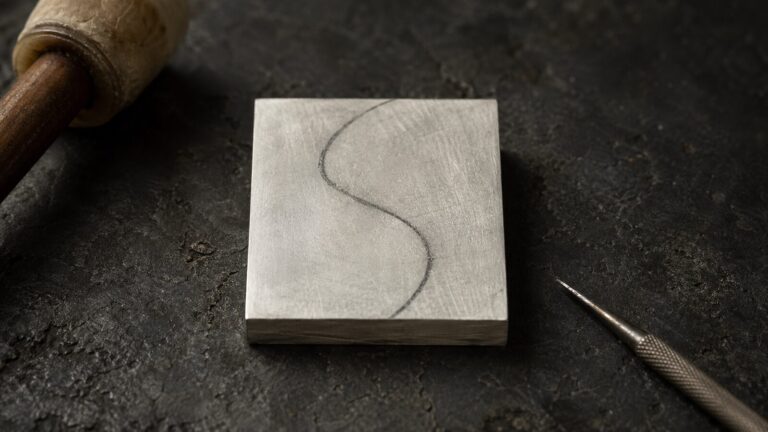
The object rests at the bottom of the jar, buried under the liquid. This is a deliberate act of erasure. Every line carefully filed into the surface over the last three hours is now hidden from view. Under the desk lamp, the silver has become a heavy mass that simply absorbs light. The chemical oxidation makes no distinction between a high ridge and a deep valley; it covers everything with a temporary blankness, a necessary burial before the final texture is revealed.
Timer
Brass tweezers lift the object from the solution. It drips onto the rubber mat, leaving dark, oily stains. I watch as it is plunged into cold water to kill the chemical reaction. Then, the mechanical kitchen timer is wound to the two-minute mark.
Two minutes is not an arbitrary number. The oxidized layer stays workable only while it remains wet and the silver underneath holds its surface tension. Beyond that window, the layer begins to bond more deeply and the brush can no longer selectively lift it from the peaks. The timer is not a ritual—it is a physical constraint.
Its rhythmic ticking fills the small space over the sink. Beside the tap sits a brass-bristled brush, its wooden handle stained dark from years of use.
Controlled Abrasion
The brush meets the metal with a firm, steady pressure. The hand moves in one direction only—longitudinal, following the axis of the object. There is no circular scrubbing, only linear friction. Under the running water, a dark gray slurry forms and vanishes down the drain. A streak of dull silver suddenly cuts through the black crust. The stiff bristles dig into the raised edges but sweep over the recessed grooves, leaving the chemical layer untouched in the depths. The water clears the debris instantly, revealing the physical facts of the abrasion as the black layer is dismantled piece by piece.
Evidence
The sharp ring of the timer cuts the air. The brushing stops mid-stroke. The tap is twisted shut. After the piece is blotted dry with a linen cloth, it is placed under the harsh white bulb of the desk lamp.
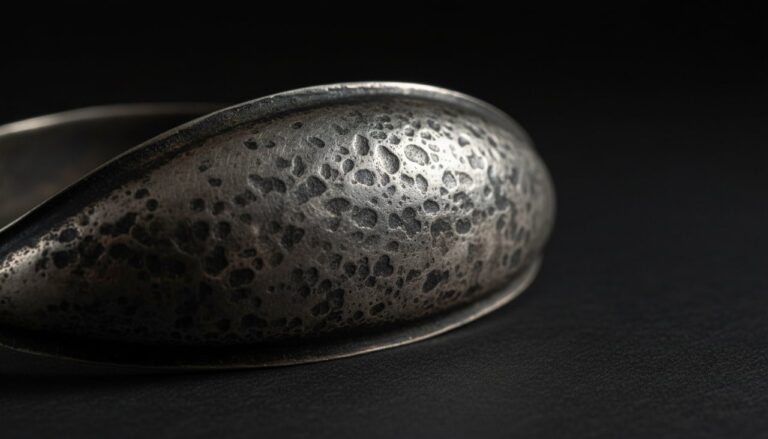
The surface is now a map of those 120 seconds of work. The deep recessed lines remain black, holding the shadow of the sulfur. The raised plateaus are matte silver. Held at an angle under daylight, the peaks catch the light and the valleys stay dark—not a gradient, but a hard line between the two. That line is the visible evidence of where the brush passed and where it did not.