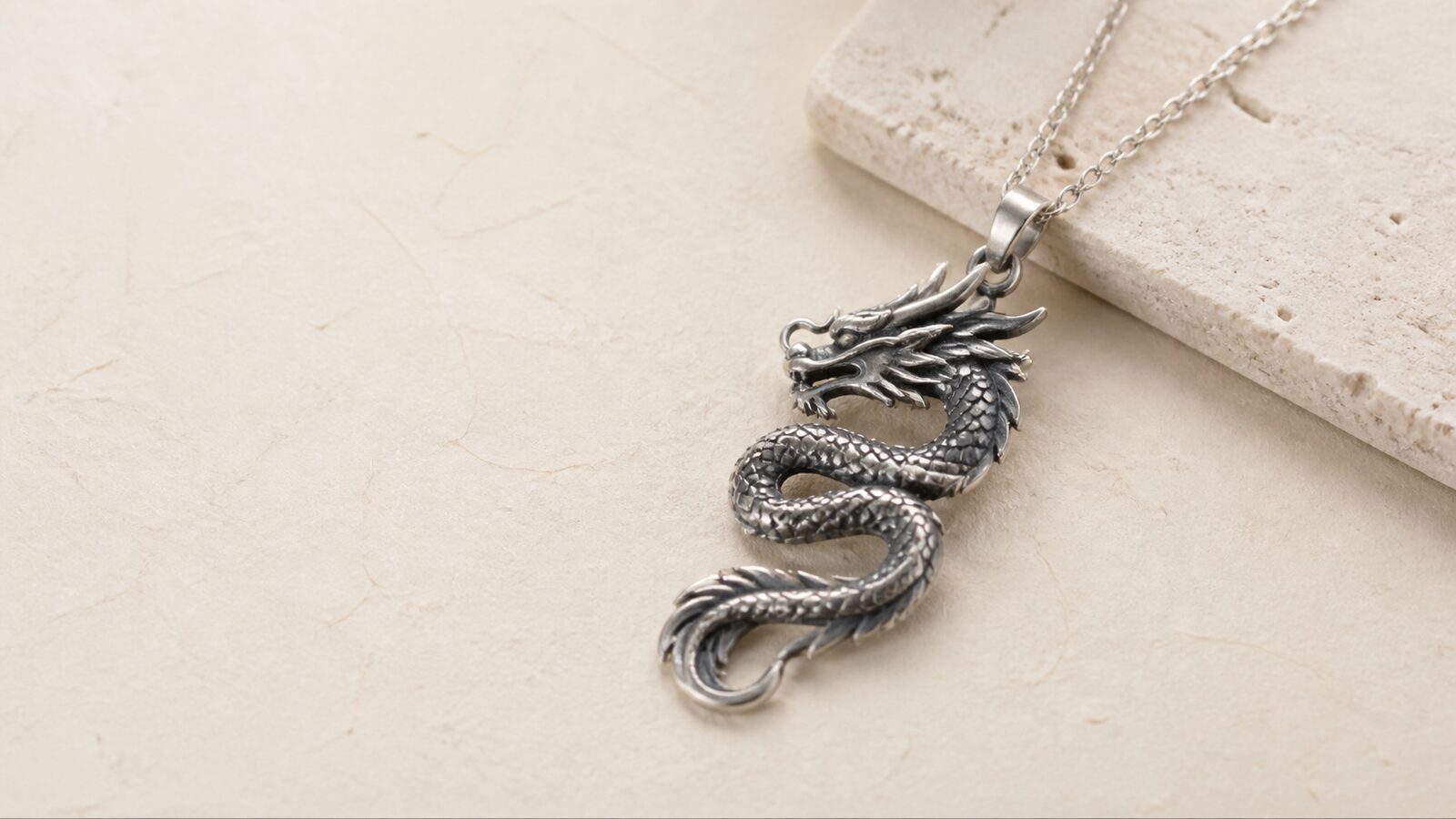
A Chinese dragon motif carries a long visual history, but a contemporary pendant does not need to borrow every historical claim attached to it. The most convincing use begins with the form itself: a long, coiling line, a changing rhythm of scales or ridges, and a balance between density and open space.
A motif with many histories
Chinese dragons appear across centuries of art and material culture, and their meanings have never been limited to one simple definition. In imperial contexts, dragon imagery could be associated with authority and benevolence; in other objects, it operates as a decorative, narrative, or formal motif. Its history is specific enough to deserve care, which is why a modern piece should not flatten it into a generic promise of luck or protection.
For contemporary jewelry, the dragon can instead be approached as a study in line and movement. A pendant may suggest continuity through a coiling silhouette, or use scales to turn light into a repeating surface. That is a personal reading of an object, not a supernatural claim.
Respectful contemporary use also leaves room for difference. A museum object, a ceremonial garment, and a small silver pendant do not carry the same social role. Rather than claiming a single timeless meaning, jewelry can acknowledge the motif’s cultural history and be clear about its own: a designed object for adornment, touch, and individual interpretation.
Why the coiling line works in jewelry
A long curve gives a compact object a sense of motion. Unlike a rigid, symmetrical outline, it can pull the eye around the form and create a clear front, back, and resting point. The spaces between the curve matter as much as the metal: open areas keep a pendant legible against fabric, while denser sections give it visual weight.
Scale texture changes the experience again. In a small piece, it need not be literal or armor-like. A sequence of shallow ridges, faceted planes, or incised marks can suggest movement while keeping the surface comfortable against the body.
Detail without visual noise
Dragon imagery can become visually crowded when every surface is treated with the same intensity. In jewelry, a quiet section of polished or softly matte silver is often what lets a patterned section read. The eye needs a pause between a coiling body, a head or tail, and any repeating scale texture. Negative space performs the same work: it makes a compact form feel lighter and keeps its outline from becoming a silhouette of undifferentiated detail.
That balance is especially important in a pendant intended for everyday wear. The object should still be recognizable in normal light and at normal viewing distance. Fine detail can reward a closer look, but it should not be the only thing holding the design together.
Silver, contrast, and touch
Silver responds strongly to finish. Brighter high points can bring a raised line forward; darker or matte recesses can make the pattern recede. The contrast is most effective when it follows the structure of the form rather than covering every area with detail. A restrained finish also leaves room for the material to change gently with wear.
Because a pendant sits close to the body, proportion and comfort should guide the design. Edges should be finished smoothly, bails should allow the piece to hang naturally, and surface texture should invite touch without catching on clothing. These are the details that make a symbolic form practical in daily life.
Care follows the finish rather than the motif. Bright silver can be wiped with a soft cloth after wear; textured and darkened surfaces should not be aggressively polished, because brightening every recess can erase the contrast that defines the piece. Store a pendant separately when possible so it is not rubbed continually by other metal items.
Choosing a dragon pendant with intention
- Look for a silhouette that remains clear at the pendant’s actual scale, not only in a close-up image.
- Check the relationship between raised texture and smooth edges; visual detail should not compromise comfort.
- Choose a finish that suits how you wear jewelry: polished, matte, and oxidized silver will all show use differently.
- Read cultural motifs with specificity. A dragon is not a universal shorthand, and its historical context should not be reduced to a sales claim.
A contemporary reading
The lasting appeal of the dragon motif lies in its capacity for movement: a continuous line can feel active without becoming loud. In a contemporary silver pendant, it can remain an object whose meaning is shaped by the person wearing it, rather than a promise made on their behalf.
References
- The Metropolitan Museum of Art: Panel with dragons amid clouds — historical context for dragon imagery in Chinese art.
- The Metropolitan Museum Journal: The Dragon and the Pearl — scholarship on the dragon-and-pearl motif and its historical development.
Frequently Asked Questions
Its historical meanings vary by period and context. In contemporary jewelry it can be appreciated as a cultural and visual motif without making claims of luck, protection, or other supernatural effects.
A clear, well-proportioned silhouette, smooth finished edges, a stable bail, and texture that does not catch on clothing all matter.
Sterling silver can tarnish over time. Routine wiping and dry, separate storage can help limit unnecessary surface change.