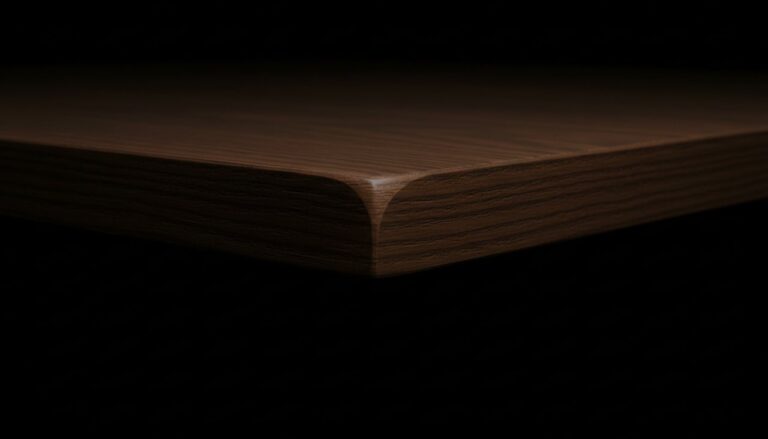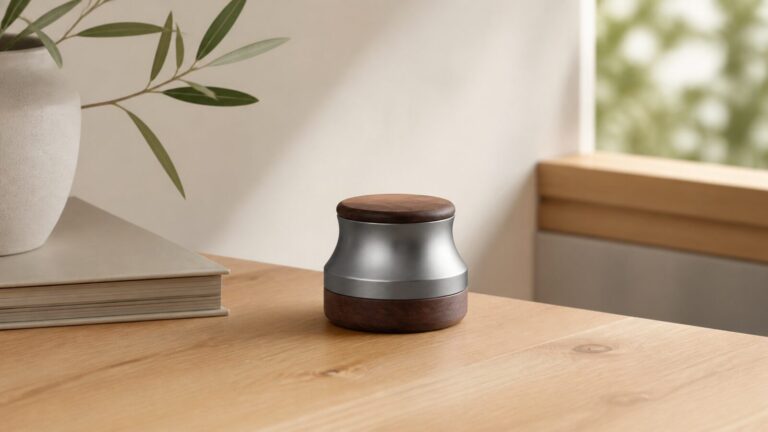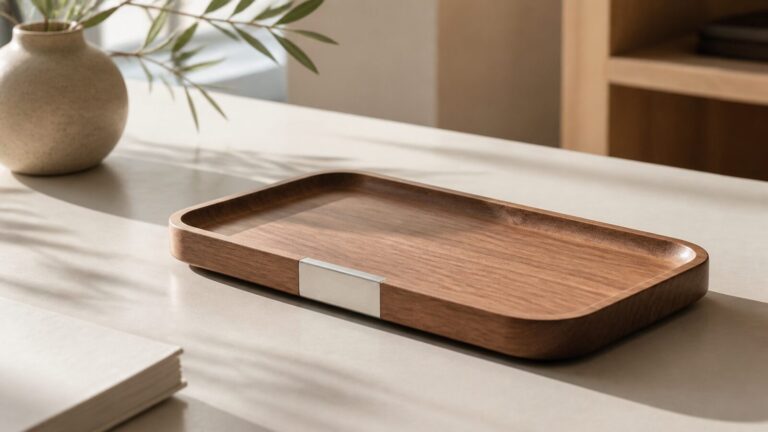
In jewellery, empty space is not the absence of design. It is one of the tools that gives a form its proportion. An opening removes some mass, but the felt lightness of a ring depends on more than how much material is gone. It can frame a material contrast, leave the skin visible as part of the composition, and change how the remaining weight is distributed and perceived.
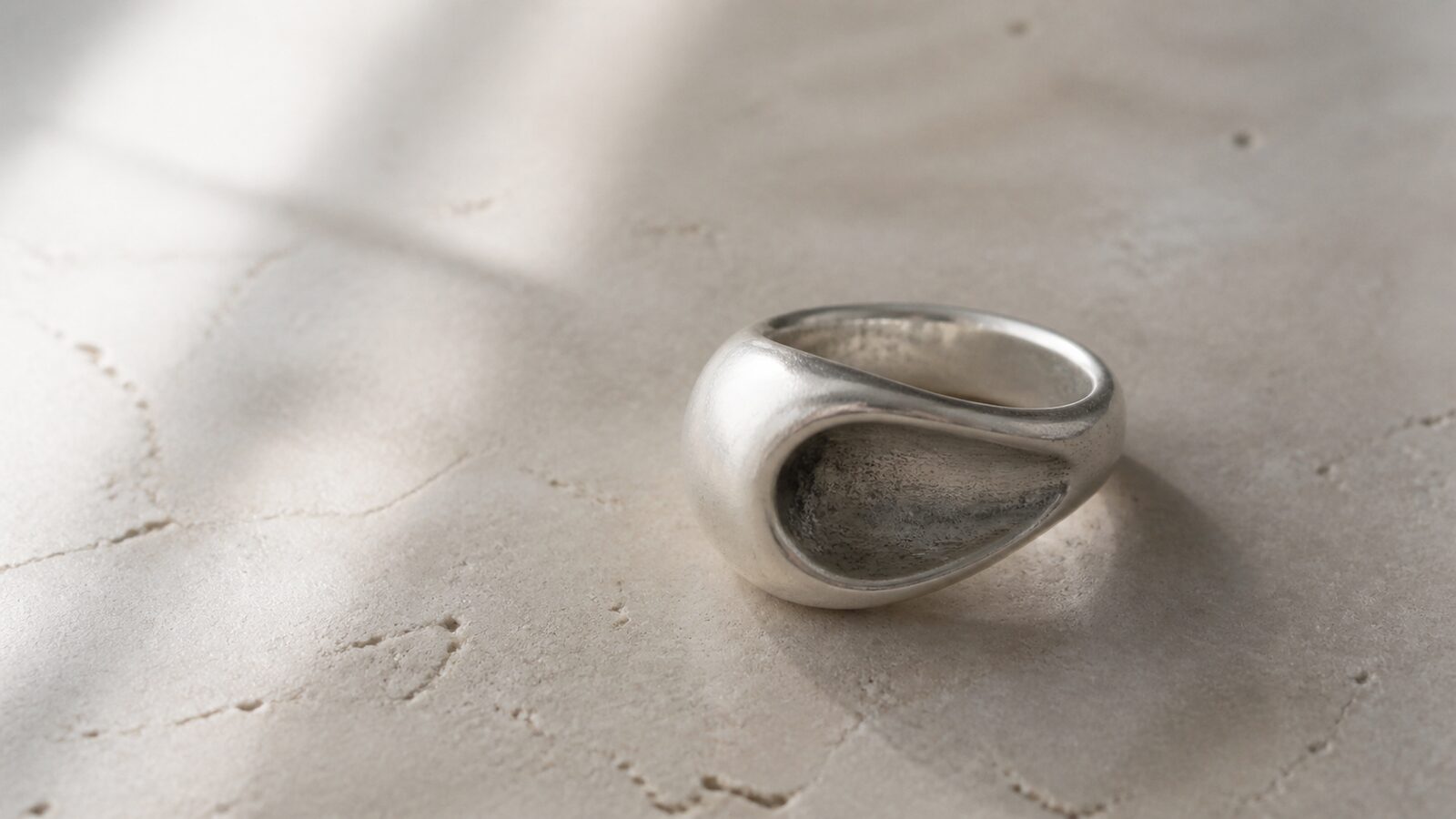
Why an opening changes the whole form
A solid mass has one continuous silhouette. Cut a space into it and the eye begins to move around an edge, across the gap and back to the material. That movement can make a compact ring look more open, or make a pendant feel less like a plaque. The empty area gives the surrounding silver or wood a boundary to describe.
In a small object, this is a matter of proportion. A narrow opening may read as a shadow line; a wider one may become the focal point. The goal is not to maximize emptiness, but to leave enough of it for the material to breathe.
Visual lightness is different from physical lightness
Removing material can reduce mass, but visual lightness comes from several decisions at once: the thickness of the remaining edge, the position of the opening, the direction of the curve and the finish. A thick band with a clean internal void can still feel substantial in the hand. A thin, highly polished outline can look lighter but catch attention more aggressively.
Matte silver is especially useful here because it keeps reflections broad and quiet. Wood adds another effect: a grain can make a solid inlay feel active, so a small interval of plain silver or open space may be what keeps the composition from becoming crowded.
Edges make a void feel intentional
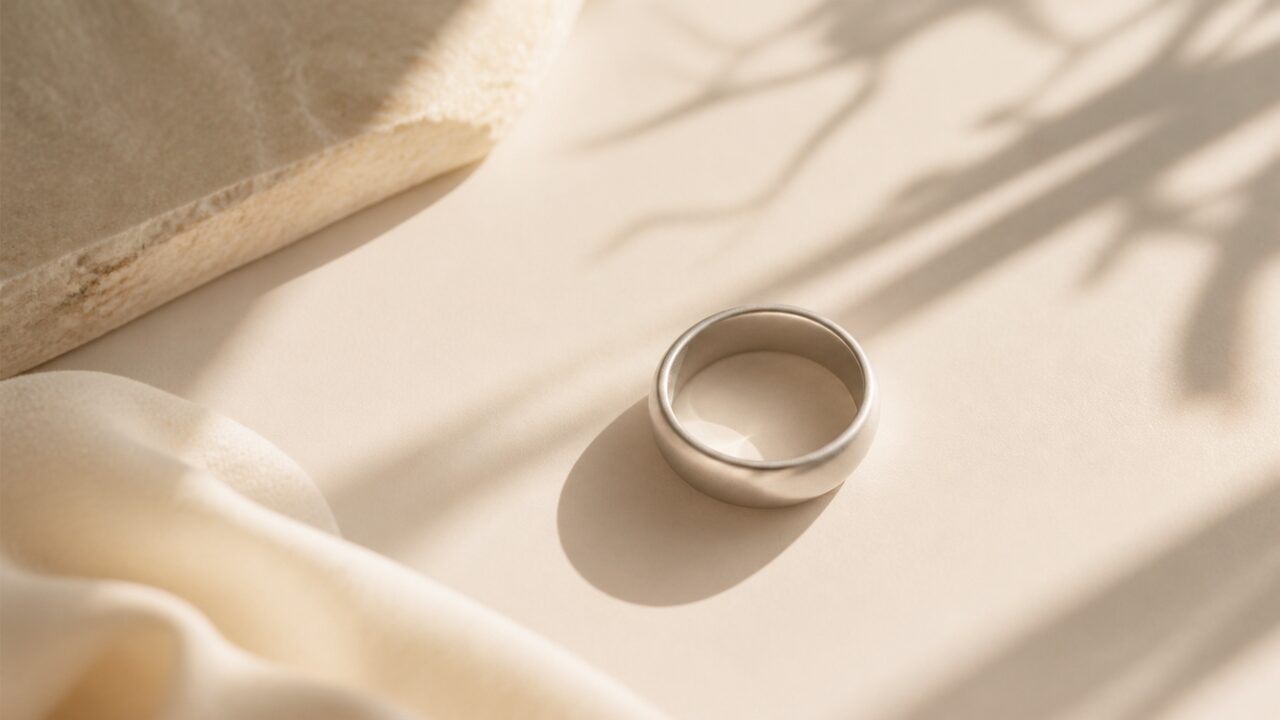
Negative space is defined by what surrounds it. A crisp silver edge makes an opening read more architectural; a softened edge makes the same opening feel more bodily and continuous. Neither treatment is a default. The choice depends on whether the form should appear cut from a plane, grown around the finger, or suspended around a central material.
Light helps reveal that decision. A matte edge holds a broad shadow beside an opening, while a polished edge can make the contour flicker as the hand moves. In a restrained piece, one small reflective point may be enough. The rest of the surface can remain quiet so that the gap does not turn into a decorative outline.
Where negative space belongs
Openings work best when they clarify an action or a contour. Around a finger, they can follow the curve of the hand. In a pendant, they can separate a central material from its frame. At the junction of wood and silver, a slim gap can make the meeting legible without imitating a screw, hinge or industrial part.
They need practical attention as well. An opening should not create an edge that catches clothing, weakens a stressed point, or makes cleaning impossible. This is why a good void feels inevitable: it has a visual reason and a structural reason.
Negative space can create rhythm
Repeated solids often need a pause between them. A narrow opening can separate a darkened band from a wood inlay. A larger cut-out can establish a slower rhythm: material, air, material. This sequence gives the eye a route through the design. It is particularly helpful when different textures meet, because the void keeps the transition from becoming an argument between two surfaces.
There is a useful restraint test. Cover the opening with a finger in a photograph. If the form becomes crowded, the space was carrying a real compositional job. If nothing changes, the opening may be an unnecessary gesture. The test does not replace making or fitting, but it is a practical way to see whether an absence actually contributes.
Comfort gives the abstract idea a limit
A ring is not a drawing. The internal contour has to sit comfortably; exposed corners need enough rounding; and the thickness around any opening has to suit the intended use. The widest cut-out is not automatically the most elegant one. Often a smaller interval, placed where the form naturally turns, feels more resolved because it acknowledges the movement of the hand.
Seen this way, empty space is not a symbol to decode. It is a measured condition that lets weight, texture and contour remain distinct. The design becomes lighter to read while still feeling substantial to wear.
Restraint is a useful test
When a design feels heavy, adding more texture is rarely the answer. First see whether it needs a pause. A quiet area can make a darkened recess more convincing, a grain more visible, and a curved piece of silver easier to understand. Empty space does not ask to be admired on its own; it makes the materials around it more precise.
Frequently Asked Questions
It is an intentional open area that shapes the contour, frames materials and gives the eye a pause.
It removes some mass, but the visual sense of lightness also depends on proportion, edge thickness and finish.
It should support the form without creating weak points, sharp edges, snagging risks or hard-to-clean areas.