Jewelry scale for men is not about rules of masculinity. It is about proportion. A piece can be small and still feel strong. It can be large and still feel controlled. The question is whether the object belongs to the body, the clothes, and the moment.
Most jewelry mistakes come from scale mismatch. A pendant is too small for a heavy jacket. A ring is too large for the hand. A bracelet is too thick beside a slim watch. The object may be well made, but it does not sit in the right visual weight class.
Read the Body First
Hands, wrists, neck, shoulders, and height all affect jewelry scale. A narrow wrist usually needs a quieter bracelet. A broad hand can carry a wider ring. A longer torso can handle a lower pendant better than a short torso.
This does not mean large men must wear large jewelry or smaller men must wear tiny pieces. It means the first choice should respect proportion before trend.
Match Jewelry to Clothing Weight
Clothing has visual weight. Denim, leather, wool, boots, and structured jackets can support stronger jewelry. Fine knitwear, linen, and clean shirts usually need quieter pieces.
- Heavy clothing can handle thicker rings, larger pendants, and darker finishes.
- Light clothing works better with slimmer chains, smaller rings, and cleaner surfaces.
- Minimal outfits allow one strong object to stand out.
- Layered outfits need jewelry that does not fight collars, cuffs, or watch straps.
Use One Anchor Piece
The easiest way to control scale is to choose one anchor piece. It might be a pendant, ring, bracelet, or watch. Everything else should be quieter.
If the pendant is strong, keep the ring simple. If the ring is wide, skip the bracelet. If the watch is large, choose jewelry that does not duplicate its weight. This keeps the outfit from feeling crowded.
Understand Finish as Scale
Finish changes perceived size. Polished metal looks louder because it reflects light. Matte metal feels smaller and more tactile even when the dimensions are the same. Darkened grooves, brushed surfaces, and patina can make a piece feel grounded instead of flashy.
For men who want jewelry to look lived-in rather than decorative, matte silver and aged surfaces are often easier to wear. They reduce glare and let the form matter more than shine.
Bracelet Scale
Bracelets need special care because they compete with watches and cuffs. A thick bracelet beside a thick watch can make the wrist look crowded. A slim bracelet beside a large watch may look accidental. The better move is contrast: one piece with weight, one piece with restraint.
If a bracelet uses beads or links, check how it behaves while typing, driving, and putting on a jacket. A bracelet that looks good only when the wrist is still will not become part of daily wear.
Ring Scale
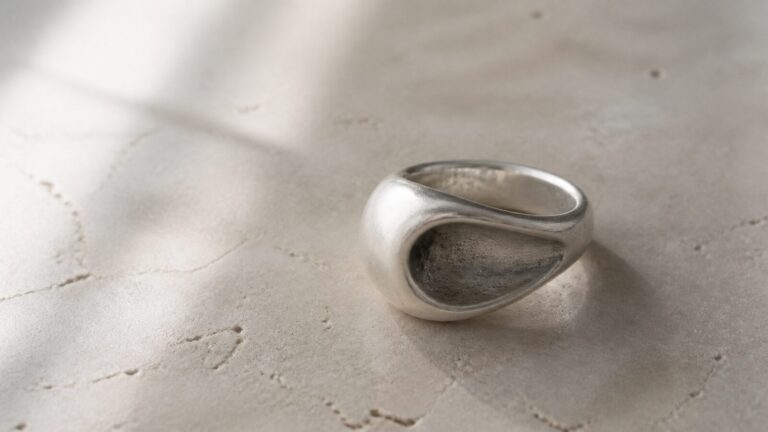
Rings should be judged with the hand relaxed. A ring that looks dramatic in a close-up photo can look excessive when the hand is moving. Width, height, and face size all matter. A low wide band can feel more wearable than a tall narrow ring because it stays closer to the hand.
Pendant Scale
Pendants are judged against the chest and neckline. The chain creates the frame; the pendant creates the focal point. If the pendant is large, the shirt should be simple. If the pendant is small, the chain and neckline need to keep it from disappearing.

A quieter pendant can carry visible form without becoming the loudest part of the outfit, especially when the clothing is already structured.
Scale Is a Habit of Looking
Choosing men’s jewelry becomes easier when you stop asking whether a piece is bold or subtle in isolation. Ask what it does beside the hand, the wrist, the collar, and the fabric. Good scale makes jewelry feel inevitable. Poor scale makes it feel added at the last minute.