A men’s pendant necklace can look effortless or completely misplaced, and the difference is usually not the pendant itself. It is size, chain length, neckline, and how much else is happening around it.
The right pendant gives the upper body a center. It can sit quietly under a shirt, sharpen a plain T-shirt, or add weight to a jacket. The wrong one swings too low, shines too much, or turns every outfit into a costume.
Start With Pendant Size
Size is the first decision. Small pendants feel private and minimal. Medium pendants are the most flexible. Large pendants need confidence, simple clothing, and enough physical presence to avoid looking borrowed.
- Small pendants work under shirts, with thin chains, and in cleaner wardrobes.
- Medium pendants are easiest for daily wear and visible styling.
- Large pendants should be treated as the main object in the outfit.
If the pendant has strong geometry, carved detail, or a symbolic form, let the size stay moderate. Detail already carries visual weight.
Choose Chain Length by Neckline
Chain length should respond to clothing. A pendant that sits perfectly with a crew neck may disappear awkwardly under a button-up shirt. A chain that looks relaxed with linen may feel too casual with a structured jacket.
As a practical rule, shorter chains feel cleaner and more controlled. Longer chains feel more relaxed and more visible. The right length lets the pendant land where the shirt gives it space.
- Crew neck: use a chain that lets the pendant sit just below the collar line or keep it hidden.
- Open collar: a medium chain can sit inside the opening without swinging too low.
- Overshirt or jacket: a slightly stronger pendant can work because the outer layer gives it structure.
- Formal shirt: keep the pendant small or hidden unless the styling is deliberately casual.
Think About Material Weight
Material changes how a pendant behaves. Silver has physical coolness and visible density. Jade feels smoother and quieter. Steel can feel harder and more industrial. Wood or cord details soften the look but also make the piece more casual.
Weight is not only about comfort. A pendant with enough weight hangs better. It moves less, sits flatter, and feels more intentional against the body.
Keep the Rest of the Outfit Simple
A pendant does not need many companions. If you wear a necklace, ring, and bracelet together, one piece should lead and the others should support it. The easiest combination is one pendant, one watch, and maybe one restrained ring.
Clothing should create a clean field. Plain black, white, gray, denim, wool, and washed cotton all give silver and stone enough contrast. Busy prints make pendant styling harder unless the pendant is very small.
When a Pendant Has Strong Form
Some pendants are not neutral. A tooth shape, dragon form, moon form, or carved medallion carries visual story even before the wearer explains it. That can work well, but it needs restraint around it.
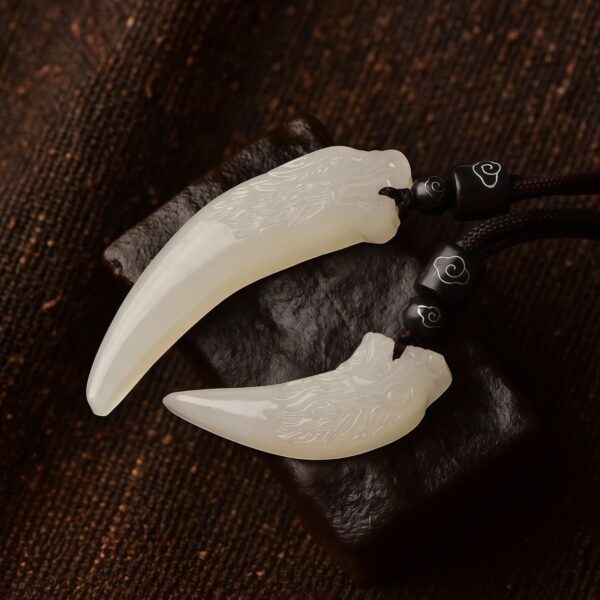
A pendant with this much shape works best as the single visible object at the neckline, especially with plain fabric and a simple chain.
The Best Pendant Feels Deliberate
A men’s pendant necklace should not look like an afterthought. Choose the size first, then chain length, then material, then the amount of symbolism or detail you actually want to carry. If the pendant works with your simplest clothes, it will usually work with everything else.