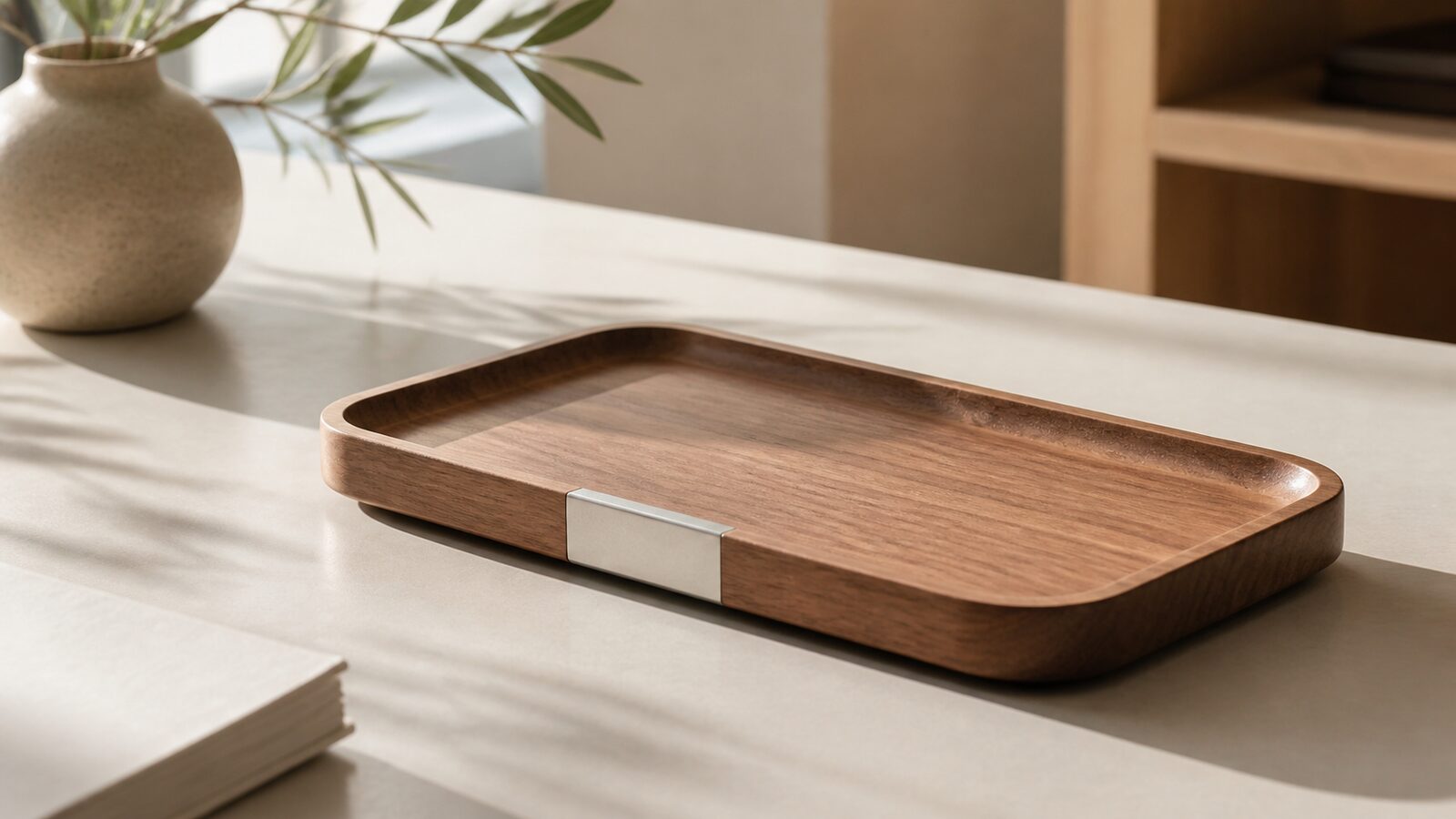
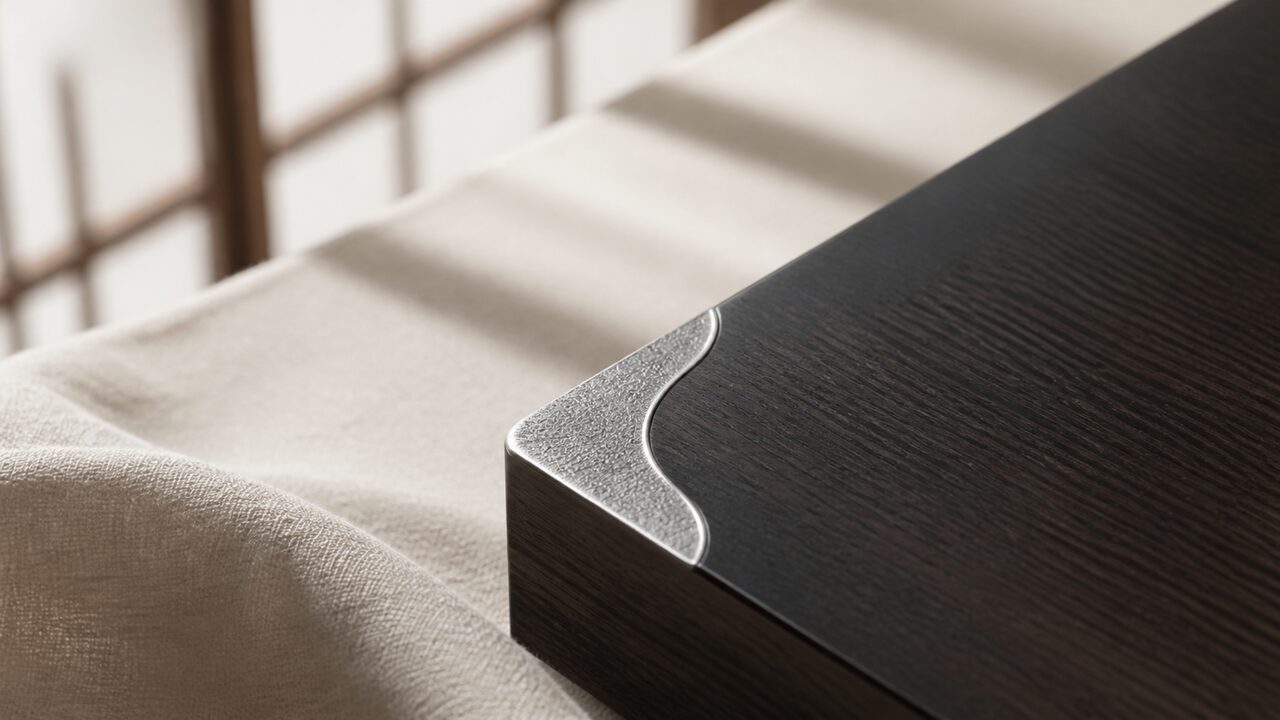
When my hand leaves the keyboard and rests on the wooden tray, the first thing I notice is not the wood. It is the cool line of the metal inlay under my thumb. That brief change in temperature offers a small, welcome break from the screen in front of me.
A Quieter Desk Object
Cluttered, glossy, or overly decorated objects can make a desk feel busier than it needs to be. A workspace filled with reflective surfaces and competing colors asks a little more of the eye than a calmer one does. Choosing materials that are restrained and understated is one simple way to keep a desk feeling settled rather than noisy — not because it will fix a chaotic day, but because a plain, matte surface simply asks less of you when you glance at it.
Where Wood Meets Metal
Look closely at the joint where wood meets metal on a piece like this, and you won’t find any visible adhesive. Instead, the maker relies on friction and careful measurement to hold two very different materials together — an approach drawn loosely from joinery traditions found across East Asian furniture-making, adapted here for a small, modern object rather than a full-scale piece of furniture.
This kind of joint puts two different materials into quiet tension with each other. Metal contracts slightly as temperatures drop; wood expands as humidity rises. Cut with the right tolerance, the joint can flex gently with those small seasonal shifts instead of splitting or loosening.
The five-element framework of Chinese philosophy is sometimes used to describe this pairing — metal associated with contraction and structure, wood with organic growth and expansion. It’s a poetic way of naming a relationship that makers have long worked with through trial, seasonal change, and careful fitting, rather than a technical formula in itself.
A Dense, Slow-Grown Hardwood
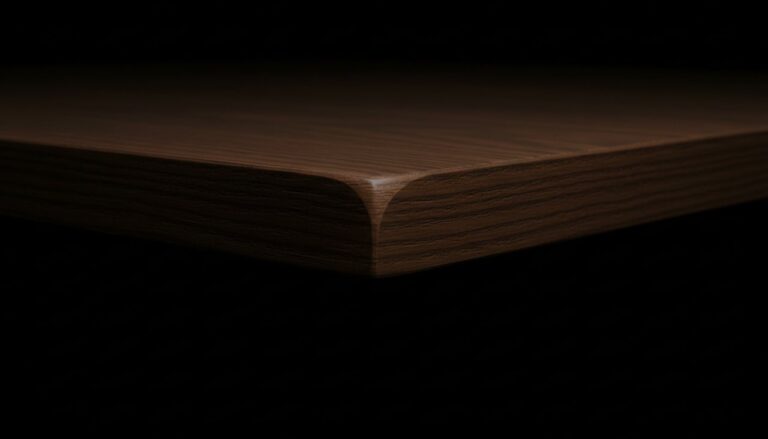
The hardwood used in pieces like this is selected for density and stability — wood that has grown slowly and developed a tight, even grain, which tends to resist warping and splitting over time. Denser hardwoods like this generally take more effort to shape and finish than faster-growing, lighter woods, but they reward that effort with a surface that feels solid and settled underfoot or under hand.
This density gives the finished object a certain steadiness. It doesn’t flex or give easily under normal use, which lends it a grounded, permanent feel on a desk.
A Matte, Diffused Silver Surface
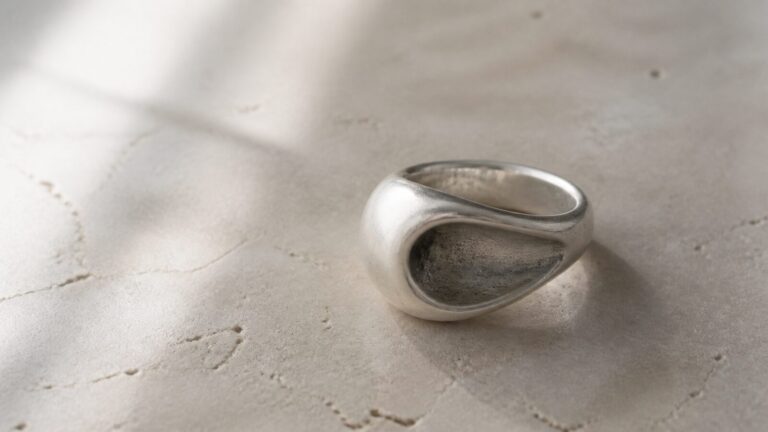
To get a calm, non-reflective surface, a silver blank is typically sandblasted with a fine abrasive. This turns a shiny, mirror-like metal into an opaque, even plane. The intent lines up with the idea of shibui — a Japanese aesthetic principle that values understatement and quiet restraint over ornamentation.
The surface roughness is carefully controlled so that light scatters evenly across it rather than bouncing straight back as glare. Instead of throwing a sharp reflection back at you, the metal breaks the light apart into something softer. In this design, the silver plays a supporting role, framing the object’s edges without pulling focus from the wood.
Leaving Room Around an Object
Where and how an object sits on a desk is its own kind of decision. Some designers draw on the idea of ma, a Japanese concept of meaningful empty space, to describe the value of leaving room around an object rather than filling every surface.
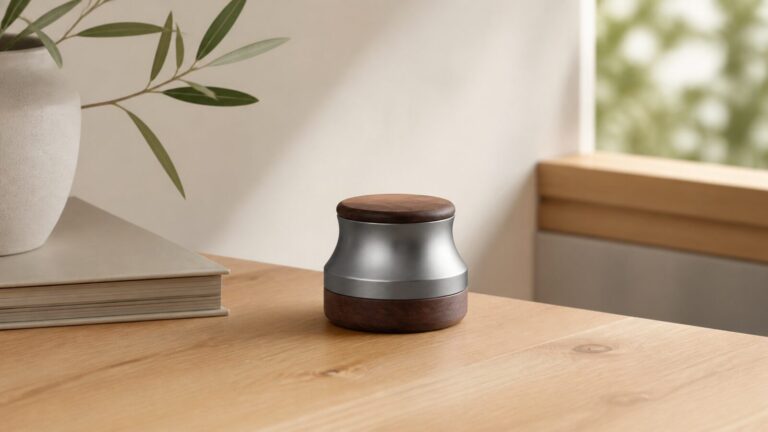
A desk with generous open space around a single object tends to feel calmer than one that’s crowded with things. That spacing keeps the eye from catching on overlapping edges and messy silhouettes, and makes the desk easier to take in at a glance.
The proportion between materials matters too. Keeping the metal component relatively small compared to the wood means the warmth of the wood stays the dominant sensation whenever you touch the object, with the silver acting as a quiet accent rather than a competing focal point.
This is a compositional choice rather than a formula. A narrow silver inlay can give a wooden tray an edge to follow; a larger metal field can make the same piece feel cooler and more graphic. The useful question is whether each material has enough unbroken area to be understood. When several textures, finishes and symbols compete in a small footprint, the object becomes harder to read.
Modern Eastern design need not reproduce an antique object or turn cultural vocabulary into decoration. It can work through restraint, proportion, material contrast and an awareness of empty space. Those principles are open enough to support a contemporary object while remaining specific about what the eye and hand can actually encounter.
How the Materials Age
When an object like this is first placed on a desk, its surface is just a starting point. Over months of handling, friction and the natural oils from your hands gradually change both materials.
Tannins in the hardwood react to light and air over time, often pulling a deeper red-brown tone to the surface. Meanwhile, the matte silver slowly oxidizes, developing a cooler, grey-black tarnish in the corners and recesses that see the most contact.
Caring for a surface like this is simple. A dry cloth removes dust. A barely damp cloth, used occasionally, handles the rest. No solvents or polish are needed — the goal isn’t to keep the object looking new, but to let it age cleanly on its own terms.
The marks that build up stay small: a softer edge where a thumb rests most often, a darker corner where silver has met air and skin, a slightly warmer tone in the wood beside it.
The object keeps a quiet record of use, without needing to be restored.